


There are no products in your basket.
Investigating The Secret Lives Of Endangered Sharks And Rays
Over the past three decades, satellite tagging has become an increasingly common approach to investigate the movements and diving behaviour of all manner of marine megafauna, including of course sharks and rays. And while tagging is not without its detractors as an invasive procedure, it nonetheless remains one of the best tools we have to shed light on the often amazing daily routines of marine wildlife. In my work as a marine conservationist, we’ve seen time and again that the data and insights we gain from satellite tagging endangered sharks and rays is invaluable in convincing governments and communities to protect these species.
The majority of satellite tagging of elasmobranchs (sharks and rays) is conducted through targeted capture of individuals, which are then brought on board or alongside a research ship and kept oxygenated and wet while a team quickly measures and tags the animal before releasing it. In the case of species which reliably aggregate to feed or use cleaning stations, such as reef manta rays, scientists are able to deploy tags to free-swimming individuals using pole spears. However, some species, due to either their size or habitat, call for more creative approaches to tagging; below I describe my experience with a few such magnificent but difficult to tag species!
Whale sharks are the largest fish in the sea, reaching up to 18m in length and weighing up to 34 tons – not a good candidate for dragging on to a ship to tag! Fortunately, in Indonesia we’ve been able to take advantage of the fact that whale sharks there are occasionally caught in bagan lift nets, which provides a unique opportunity to affix satellite tags to their dorsal fins before releasing them. My team and I pioneered this approach in 2015, and the custom “bling” (with two-year battery life!) has enabled us to track some of our whale sharks for up to 26 months as they have made some amazing movements – such as the individual that swam from West Papua to the Marshall Islands and back, then to Palau and back, covering over 23,000 km! Many of our tagged sharks regularly dive to 1900m or more – what are they doing at such crushing depths in near freezing temperatures?

A whale shark in West Papua, Indonesia, sporting a new fin-mounted satellite tag. Photo by Mark Erdmann.
Another endangered shark species that we’ve been focusing on recently is the pelagic thresher shark, Alopias pelagicus. Though commonly caught as bycatch in tuna fisheries, they have a high mortality even when released, and consequently very little tagging work has been conducted on them and we know almost nothing about the movements of these stunningly beautiful animals. My colleague Rafid Shidqi, whom I am helping supervise for his Master’s thesis, has started a comprehensive research and conservation project on pelagic threshers in southern Indonesia – and we’ve again been pioneering both satellite and acoustic tagging of this species.
In this case, we partner with local artisanal fishers that target the threshers using a unique fishing method whereby they use deep handlines (200-300m depth) and a tuft of chicken feathers concealing 6 or more hooks. The threshers, which hunt scad and other baitfish using their elongate tails like bull whips to stun their prey, strike the feather lure with their tails and are foul hooked. It frequently takes the fishers an hour or more to bring the threshers to the surface, by which time the sharks are thoroughly exhausted and seemingly dead. Suspecting we might be able to revive them, we developed a technique of approaching fishers we’d see hauling in a shark, and agreeing to purchase the shark from them at market price. We then would slide into the water with the lifeless-looking shark, quickly deploy a satellite tag and internal acoustic tag, and then take it on a “recovery swim” for several minutes to pass water over the gills. Amazingly, they would invariably recover and eventually swim off – Rafid has now tagged twenty such threshers with zero mortality! The data he is now collating will be invaluable to guide the conservation and management plan he’s developing for this species, and we’ve moreover noted that the fishermen themselves are now increasingly discussing an end to this fishery. The more they’ve learned of these animals through the tagging process, the more empathy they are developing – and now working with Rafid to look at alternative target species.
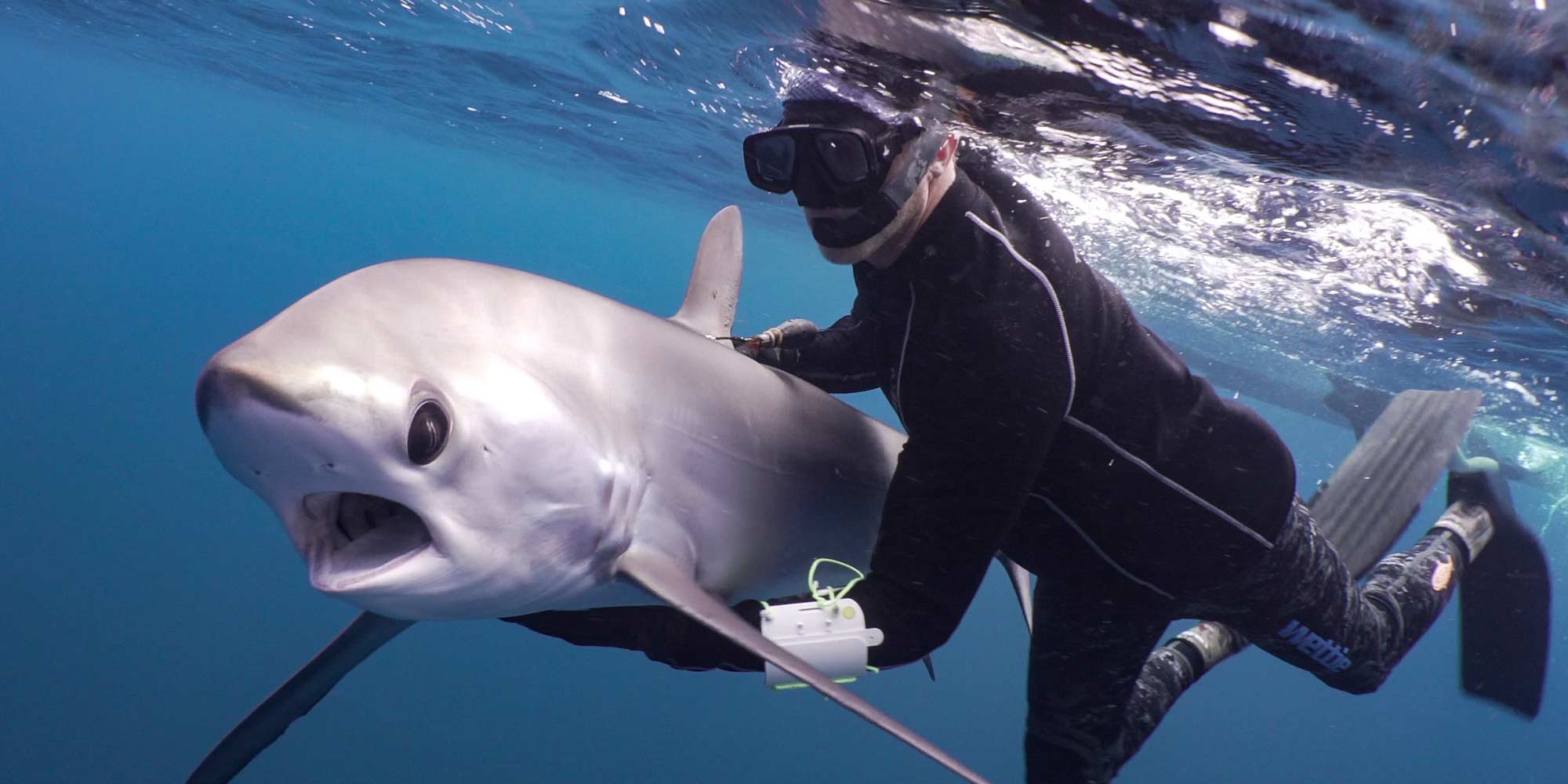
A recovery swim with a tagged pelagic thresher shark. Photo by Luca Vaime.
A final species which has proven difficult but which we’ve finally mastered a tagging technique is for oceanic manta rays off of New Zealand. Though reef manta rays have been extensively tagged throughout the Indo-Pacific, usually by approaching them while they are relatively stationary at cleaning stations, oceanic manta rays are larger (up to 7m across!), faster and frequently only seen swimming in deep offshore waters.
Though oceanic mantas have been successfully tagged in places like Indonesia where they also approach cleaning stations, New Zealand’s oceanic mantas have no known cleaning stations, necessitating a blue water tagging approach. This is easier said than done, as the world’s largest ray can easily move at speeds of 3-5m/second, even while gliding! The approach we’ve developed here is to go manta spotting on calm days when we can see their wing tips break the surface. Immediately upon spotting an animal, we put a drone in the air to “keep eyes on it”, and allow us to gauge the speed and direction it is moving. We then maneuver our speedboat ahead of the hovering manta drone by 30-50m, slip into the water and swim hard to try to intercept the manta – allowing us to tag it with a pole spear.
So far we’ve managed to tag 8 oceanic mantas off New Zealand, and have revealed the longest known migrations for this species (well over 1500km into the SW tropical Pacific) and the deepest recorded dives for mantas (over 1000m!) – again, what are they doing? Needless to say, our tagging frequently ends up posing more questions than it answers – and underscores just how little we really understand of our oceans and the incredible creatures that call it home!
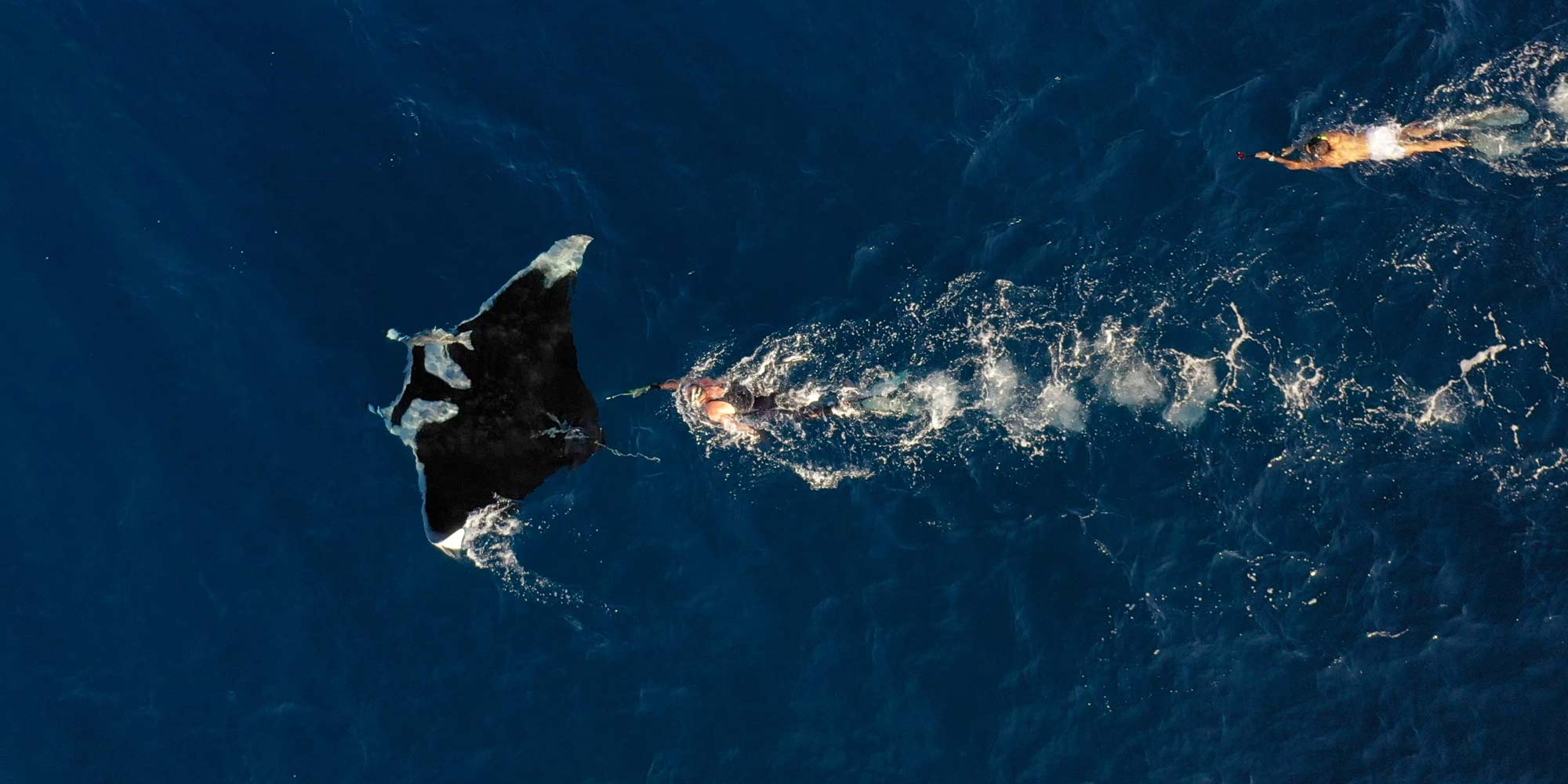
Mark tagging an oceanic manta ray offshore of New Zealand. Photo by Edy Setyawan.
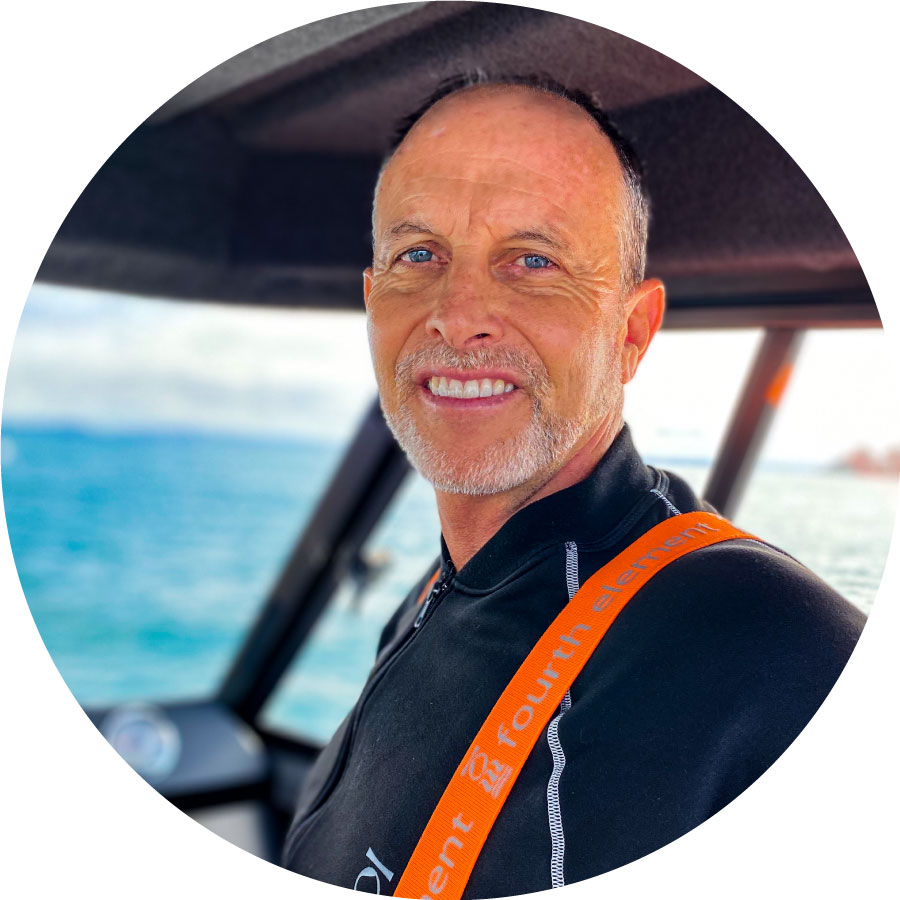
Dr. Mark Erdmann has worked as a coral reef ecologist and marine conservationist for the past 30 years, focusing on helping communities and governments to set up and manage marine protected areas throughout eastern Indonesia and especially West Papua. He’s also passionate about biodiversity, having discovered and described over 200 new species of reef fish, mantis shrimp and coral. Sharks and rays are the latest focus of his conservation research.
Dr. Mark Erdmann